7 Simple Steps For A Complete Spring Closet Reset
Spring has a way of revealing what feels heavy.
The light changes. The air feels different. You open windows more often. You notice dust that did not bother you in winter. You feel the urge to rearrange, clear, and refresh.
And then you open your closet.
It is full.
If your hangers are crowded, shelves are stacked, and drawers feel tight – getting dressed will feel harder than it should.
And let me tell you this – that tension is not about quantity alone. It is about clarity.
A spring closet reset is not about throwing everything away or building a picture-perfect capsule wardrobe.
It is about recalibrating your wardrobe so it supports your current lifestyle, your real routines, and your everyday confidence.
This guide will walk you through:
- Why your closet feels overwhelming
- How to declutter intentionally
- How to build a simple spring core wardrobe
- How to organize your closet for ease
- How to stop buying clothes you do not need
- How to maintain consistency long term
- Why spring is the best time to simplify your closet
Let’s begin.
Why a wardrobe full of clothes can still feel stressful
Many people assume that closet frustration means they need more options. In reality, the opposite is usually true.
Closets become overwhelming when they contain:
- Multiple versions of your identity
- Clothing for lifestyles you no longer live
- Pieces purchased from impulse or boredom
- Items kept out of guilt
- “Just in case” clothing for hypothetical situations
Over time, your wardrobe stops reflecting who you are now and starts representing who you were, who you hoped to be, or who you thought you should become.
That internal misalignment creates daily friction.
If you are still not convinced, here are signs your closet needs a reset:
- You change outfits multiple times before leaving the house
- You feel tempted to shop even though your wardrobe is full
- You avoid certain sections of your closet
- You repeatedly wear the same 20 percent of your clothes
- You feel mildly drained after getting dressed
Spring is the perfect time to correct this because it is naturally transitional. You are already shifting seasons, fabrics, and energy. Your wardrobe should shift too.

Why is spring the most powerful season to declutter clothes?
Spring is not just another seasonal swap.
It is the first season that removes physical layers and reveals alignment. When coats come off and fabrics lighten, you see your wardrobe clearly.
You are no longer getting away by wearing whatever you want undereneath your thick jackets.
So you suddenly notice:
- What fits differently
- What feels outdated
- What feels tight or uncomfortable
- What you avoid wearing without a coat
Outfits that worked in winter feel overcomplicated and impulse purchases stand out.
And also, spring and early summer are high-social seasons. Events increase and this increase in visibility can trigger:
- Impulse shopping
- “I need something new” thinking
- Comparison-based purchases
Decluttering in spring helps interrupt that cycle before it escalates.
When you enter high-social months with clarity in your closet, you reduce reactive spending.
So, I hope you have got enough reasons to do a spring closet declutter and reset.
Shall we begin?
Step 1: The Full Closet Reset
Before organizing or styling anything, you need complete visibility.
Remove every single item from your closet, including:
- Tops
- Bottoms
- Dresses
- Outerwear
- Shoes
- Bags
- Scarves
- Belts
- Occasion wear
This includes clothes for all seasons – everything you will wear in a year. Place everything in one visible space.
Why this matters:
- It eliminates denial about volume
- It exposes duplicates
- It reveals forgotten pieces
- It helps you identify patterns
As you look at the full collection, ask yourself:
- When did I last feel excited about most of these pieces?
- How many of these do I realistically wear in a month?
- If I moved homes tomorrow, would I pack all of this?
Do not sort yet. Just observe.
Awareness creates better decisions than emotional urgency ever will.
Step 2: Declutter With Clear Criteria
Decluttering without structure turns into hesitation. You need consistent evaluation questions.
Go through each item slowly and ask:
1. Would I choose this again today?
Consider:
- Has your style evolved?
- Does this reflect your current taste?
- Would you confidently pick this up in a store right now?
If the answer is no, it may represent an outdated version of you.
2. Does this support my current lifestyle?
Think practically.
- Do you work from home?
- Do you attend frequent events?
- Do you prioritize comfort?
- Are you more active than before?
Keep clothing that matches your real routine, and release clothing that matches a fantasy routine.
3. Have I worn this in the last 12 months?
Be honest.
If it did not make it into rotation across different seasons, it is not essential.
Exceptions may include:
- Formal wear for specific annual events
- Cultural or traditional clothing worn occasionally
Everything else should justify its space.
4. Does this mix with at least three other items?
Versatility helps to reduce decision fatigue.
If an item only works with:
- One specific pair of pants
- One specific shoe
- One specific accessory
It creates outfit stress.
A simplified wardrobe thrives on combination potential.
5. How do I feel when I wear this?
Pay attention to physical and emotional signals.
- Do you adjust it constantly?
- Do you avoid mirrors?
- Does it feel slightly uncomfortable?
- Do you feel confident and relaxed?
Confidence is not optional when it comes to wearing an outfit. If an item drains subtle mental energy, it costs more than its space.

What to do after asking the five closet questions
After you evaluate each piece using the five questions, you need to move from reflection to decision.
Do not put items back into the closet yet.
Instead, sort them into clear categories based on your answers.
Use The 3-Category Rule
For every item, ask yourself how many of the five questions received a confident “yes.”
Category 1: Strong Yes (4–5 yes answers)
These are your core pieces.
They:
- Fit your current lifestyle
- Feel comfortable
- Mix easily with other items
- Make you feel confident
Action:
- Fold or hang these neatly
- These become your spring core wardrobe
- Keep them easily accessible
These pieces earn their space.
Category 2: Mixed Answers (2–3 yes answers)
These are hesitation pieces.
They may:
- Fit well but feel outdated
- Look good but rarely get worn
- Match few items
- Feel “fine” but not great
Action:
- Move these into a temporary holding space.
- Do not return them to your main closet yet.
- Create a 30-day trial rule.
If you do not reach for them naturally within 30 days, they move to donation or resale.
Please don’t give any space to guilt or hard feelings here, as this is data based on your own experience.
Whenever I find myself in this situation, I think about the people who would benefit from the clothes I give away. It is, anyway, better than when they collect dust in my closet. And that makes me feel better.
Related: How to let go of clothes you are emotionally attached to
Category 3: Mostly No (0–1 yes answers)
These pieces usually reveal themselves quickly, because you find that,
They do not fit your current life.
They have not been worn.
They do not mix well.
They do not make you feel confident.
If hesitation appears here, listen carefully to the reason.
If the reason sounds like:
- “What if I need this someday?”
- “It was expensive.”
- “I might wear it when I lose weight.”
- “Maybe trends will change.”
That is not uncertainty. That is attachment.
These are “just-in-case” pieces.
And at this point, the sorting is complete, and we move on to the next step.
Step 3: Release The “Just In Case” Category
This category is often the largest source of clutter.
As we said in the last section, it includes:
- Clothes for a future body
- Trend pieces that never felt fully “you”
- Sale items purchased because they were discounted
- Outfits kept for events that rarely happen
Just-in-case clothing is not a separate pile.
When you go through each piece and ask the declutterer questions, you will find that it is a pattern of thinking that shows up during decluttering.
It often appears in items that scored very low during your five-question review but still feel emotionally difficult to let go.
Just-in-case pieces usually represent:
- A past identity
- A future hypothetical body
- A version of life that no longer exists
- Guilt over money already spent
Spring is the most powerful time to release these because the season itself represents movement forward.
And remember, when you let go of fear-based clothing, you are not losing options.
You are removing the weight that keeps pulling you down in many ways, whether emotionally, mentally, or even financially.
But when you finally let them go, your closet becomes lighter, your decisions become clearer, and your identity becomes more aligned.
The five questions are there for you to give logic. And releasing just-in-case pieces gives you freedom.
Now, to do that, create three clear piles:
- Keep
- Donate or sell
- Discard
Do not create a fourth “maybe” pile unless absolutely necessary.
Note: In Step 2, we talked about moving items to the trial section. If you are wondering, not every hesitation piece is a “just in case” piece.
Just in case items are kept out of fear or fantasy. Trial pieces are kept for evidence.
If an item scored very low across the five questions, release it immediately.
If it scored somewhere in the middle and you genuinely feel unsure, give it a 30-day trial outside your main closet.
If you do not reach for it naturally, it leaves.

What to do after you sort
First, remove the Discard pile immediately.
Throw away damaged, stained, or unusable items the same day. Do not let this pile linger. Physical clutter sitting around weakens your decision confidence.
Next, deal with the Donate or Sell pile within 48 hours.
Place donation items in sealed bags and put them directly in your car or schedule a pickup. If you plan to sell items, set a realistic rule: list them within one week.
If they are not listed within that time, donate them instead. Delayed decisions often turn into re-cluttering.
Once those two piles are out of your space, pause before returning anything to your closet.
Now look at what remains – your Keep pile.
This is your reset moment.
Instead of shoving everything back in, rebuild intentionally:
- Return only the strongest yes pieces first
- Place them neatly and visibly
- Keep your current-season core at eye level
- Store off-season items that passed your evaluation
If you created a trial pile, store it separately from your main closet. It should not blend back in. That separation is what creates clarity.
When you finish, your closet should feel lighter. Not just because there are fewer clothes, but because every visible piece has earned its place.
And remember, the reset is complete only when:
- Discard is gone
- Donation is out of the house
- Keep items are organized intentionally
- Trial items are clearly separated
Decluttering is decision-making.
Resetting is follow-through.
And as you know, follow-through is what makes the change last.
Step 4: Build Your Spring Core Wardrobe
Now that you have narrowed down your clothing, you can rebuild with intention.
I suggest creating a Spring Core instead of following rigid capsule rules.
A capsule wardrobe can be helpful, but it works best after you have decluttered and clarified what you actually wear.
During your spring reset, your goal is not to hit a specific number of items.
Your goal is to identify the pieces that you own, that already support your life. Once you have that clarity, you can decide whether you want to turn that foundation into a more structured capsule.
So, your spring core could include:
- 3 bottoms that fit well and feel comfortable
- 4 breathable tops in fabrics suitable for warmer weather
- 1 light layering piece
- 1 versatile dress
- 1 everyday shoe
- 1 elevated shoe
From these pieces, create at least:
- 5 complete outfits
- 2 slightly dressed-up combinations
- 1 casual “grab and go” outfit
This foundation ensures that even on busy mornings, you have reliable options.
And here are the benefits of a spring core:
- Faster decision-making
- Reduced temptation to shop
- Clear understanding of what gaps truly exist
If you notice a genuine gap, you can add it intentionally, and not impulsively.
What about clothes for other seasons?
After your spring reset, keep only your current-season pieces visible.
- Store heavy fall and winter items you plan to wear again
- Keep summer pieces accessible, since they’re coming next
- Wash everything before storing and place it in labeled bins
- Store out of sight to reduce visual clutter, or if you don’t have enough space in your closet. If you prefer to keep them in the closet, store them in labelled bins
Here, the goal isn’t to remove other seasons. It’s to keep only what you need right now in view, so your closet feels lighter and easier to manage.
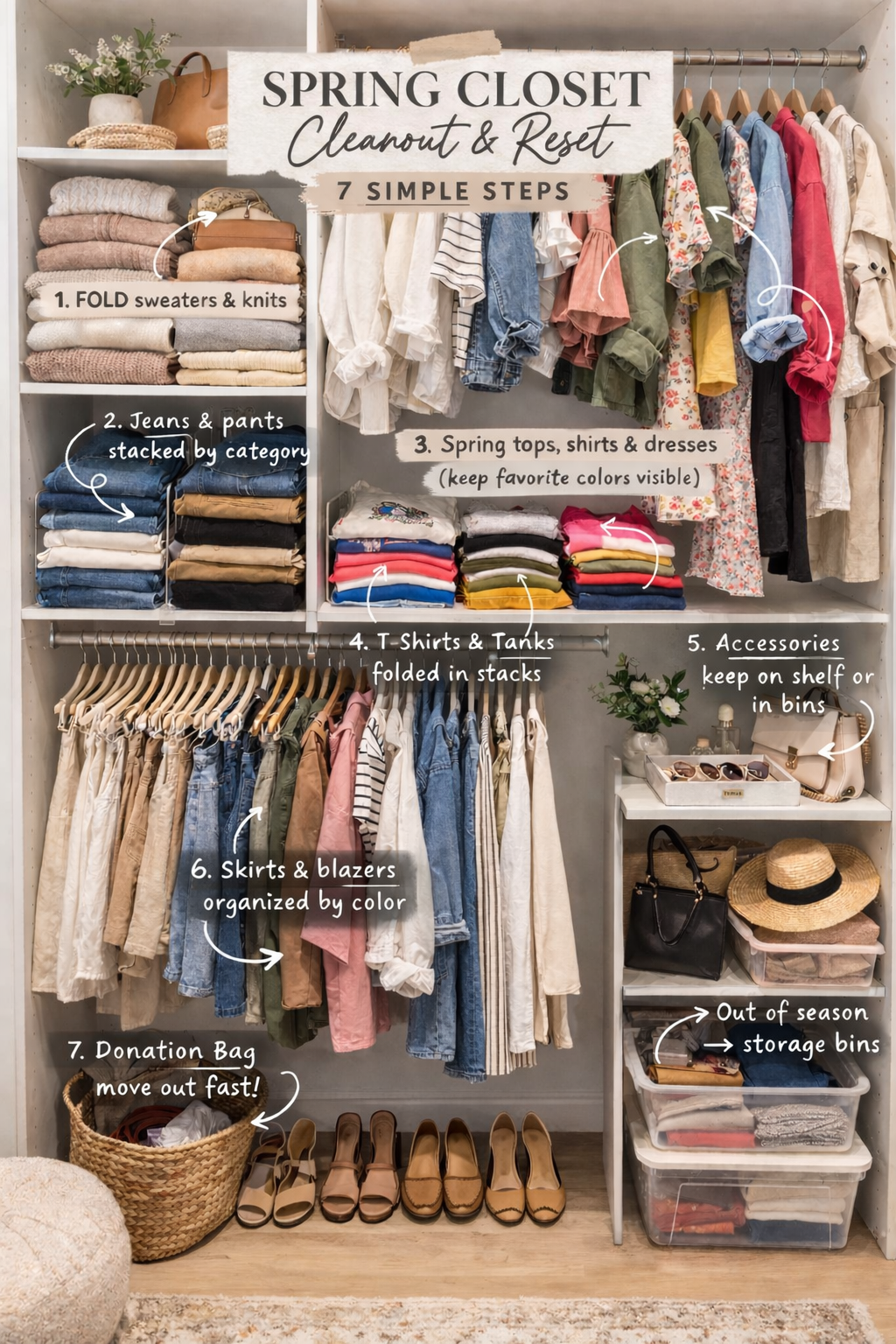
Step 5: Organize Your Closet For Clarity
This is the final stage, and I guarantee that organization will help you reduce friction and pressure.
Here, we focus more on visibility and ease, so that you always know where each item is kept.
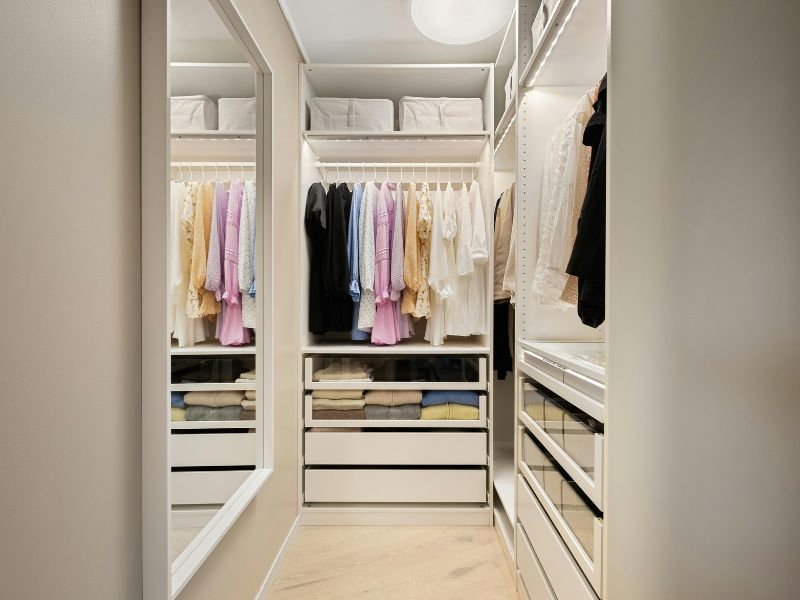
Here are some practical organization tips:
- Use matching hangers for visual calm
- Arrange clothing by category, not color first
- Keep frequently worn items at eye level
- Store off-season items separately
- Use drawer dividers for small items
- Keep only current-season shoes accessible
This method works because
- You can see what you own
- You avoid duplicate purchases
- Your brain processes fewer visual distractions
A calm closet contributes to calmer mornings, and I would say organizing properly is a must-do after the spring closet reset.
Related:
- 50 Closet organization hacks that’ll change how you use space forever
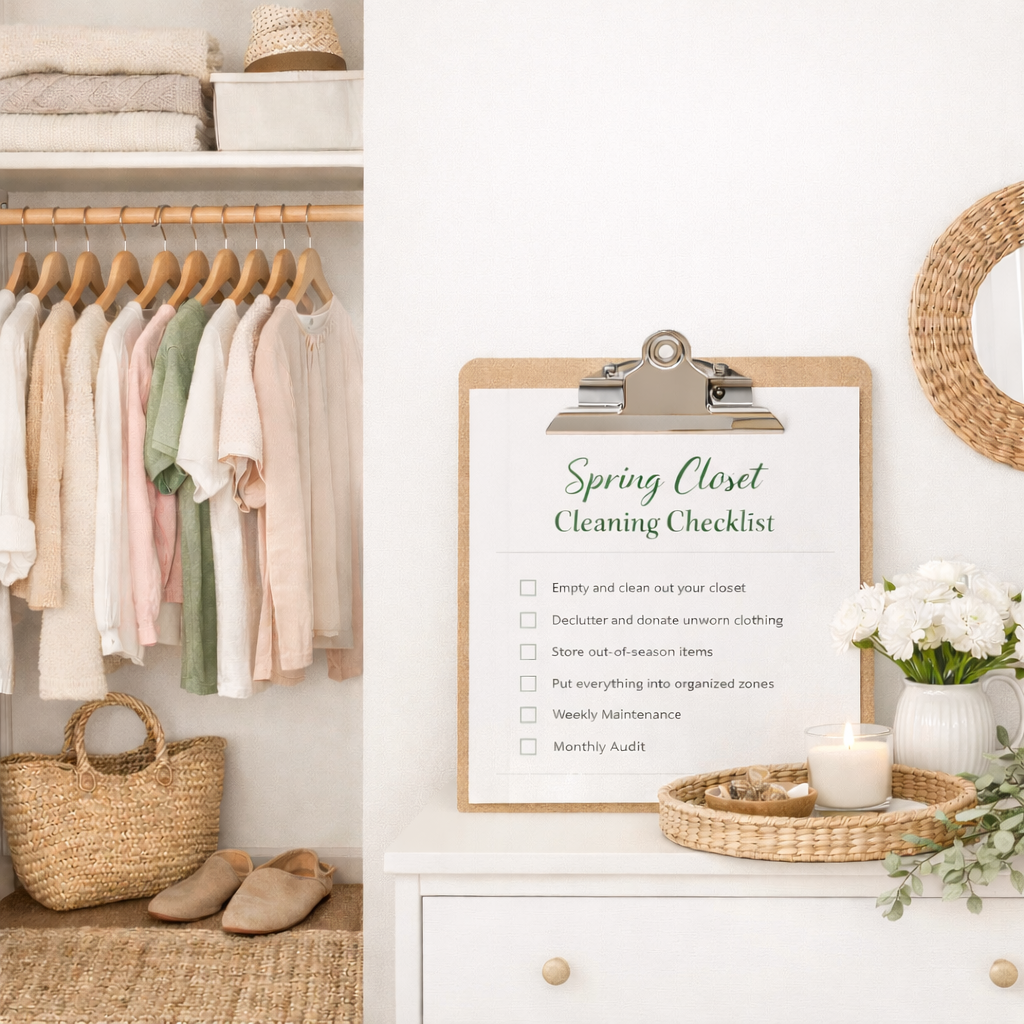
- Spring Closet Cleaning checklist (6 simple steps to a fresh, organized closet)
Step 6: Stop Buying Clothes You Do Not Need
Decluttering without habit change creates repetition.
And this is true for any habit.
You cannot start eating healthy from tomorrow if your pantry is still stocked with packaged chips. Because you know what happens when a temptation hits.
In the same way, you have to kill the habit that caused the clutter in the first place.
So, to stop overbuying clothes, introduce boundaries.
If you ask how, create a simple shopping system, where you:
- Wait 48 hours before purchasing
- Set a monthly clothing budget
- Use a one-in-one-out rule
- Avoid shopping when bored or stressed
- Track clothing purchases for 30 days
And before buying, always ask:
- What specific gap does this fill?
- Can I style this in three different ways?
- Am I shopping for dopamine or necessity?
Often, shopping serves as distraction rather than need. Understanding this reduces impulsive behavior naturally.
Related: How to stop overbuying clothes & Build a closet you’ll actually wear
Step 7: Create A Maintenance Habit
Consistency matters more than dramatic resets.
If you want to prevent future frustration, it’s better to focus on small habits that protect and maintain the reset you’ve worked hard to create.
Small habits like,
Once a week, spend five minutes to:
- Rehang misplaced items
- Refold stacks
- Remove one piece you avoid wearing
- Quick surface wipe
Once every season:
- Reevaluate your core pieces
- Remove anything that no longer fits your routine
- Adjust your foundation if your lifestyle changes
Small maintenance prevents overwhelming buildup.
And, when you have completed all these steps, you have reset your closet for spring and all the upcoming seasons.
Congratulations! It was not an easy feat, I know! But you have done it!
Now, let’s look at some benefits of the spring closet reset and how it is gonna change your life.
The psychological shift after a Spring Closet Reset
When your wardrobe aligns with your life, several subtle shifts occur, like:
- You get dressed faster
- You feel less urge to browse shopping apps (because you have clarity on your style and needs now)
- You experience less decision fatigue
- You trust your style
- You stop comparing your wardrobe to others
After a reset, you will learn that a simplified closet is not about deprivation. It is about clarity and peace of mind.
Is this different from a regular seasonal closet reset?
Yes, because this is not just about weather rotation. It is about realignment.
A regular seasonal reset focuses on swapping clothing for temperature changes, whereas a spring closet reset focuses on clarity, identity, and simplifying your wardrobe at a deeper level.
Spring creates natural momentum for letting go.
When you pair that with intentional decluttering and mindful shopping habits, you build lasting change instead of temporary organization.
Why Spring is the best time to simplify your closet
Now, let me tell you why a spring reset matters.
While you can technically declutter your closet during any season, spring carries a unique psychological and environmental advantage that makes simplification feel more natural and sustainable.
1. Spring naturally encourages transition
Unlike fall, which prepares you for inward routines and heavier layers, spring signals movement, renewal, and expansion.
The days grow longer, natural light increases, and temperatures shift gradually rather than abruptly. This gentle transition makes it easier to reassess what you wear daily.
During spring, you are already:
- Rotating fabrics
- Swapping heavy layers for breathable pieces
- Rearranging storage
- Spending more time outside
That built-in seasonal change makes it easier to question whether everything in your closet deserves to stay.
Simplifying during spring feels aligned rather than forced.
2. Increased natural light changes perception
One of the most overlooked factors is lighting.
In winter, dimmer light hides visual clutter.
Spring light is brighter and clearer. It exposes overcrowded shelves, wrinkled stacks, and pieces you may have ignored.
Natural light affects mood and decision-making. When your space feels brighter, your brain becomes more open to change. That clarity makes it easier to let go of items you would otherwise rationalize keeping.
3. Energy levels rise in Spring
Seasonal mood patterns influence behavior.
In colder months, people tend to conserve energy. Decision-making feels heavier. Major changes feel overwhelming.
Spring often brings:
- Increased motivation
- Stronger desire for order
- Renewed focus on health and habits
- Openness to fresh routines
This makes it easier to declutter without emotional attachment.
4. Spring aligns with habit reset culture
Culturally, spring is associated with “starting fresh.”
You see it everywhere:
- Spring cleaning checklists
- Fitness resets
- Home organization challenges
- Budget planning resets
This cultural reinforcement matters. When the world around you is focused on renewal, your internal resistance lowers.
5. Spring reduces emotional attachment to heavy pieces
Winter clothing often carries emotional comfort.
Heavy sweaters, layered outfits, and darker palettes can feel protective. Letting go during winter may feel premature.
In spring, that emotional weight feels less necessary. You naturally crave lightness in fabric and colors. That shift makes it easier to release pieces that no longer feel aligned.
6. The “Fresh Start Effect”
Behavioral psychology describes something called the fresh start effect. People are more motivated to pursue goals at temporal landmarks – moments that feel like new beginnings.
Examples include:
- The start of a new year
- The first day of a month
- Birthdays
- Seasonal transitions
Spring functions as a powerful temporal landmark. It marks the end of dormancy and the beginning of growth. That symbolism increases motivation to improve habits and environments.
Final Thoughts
A spring closet reset is not about starting over or stripping your closet down to nothing. It is about making intentional decisions at a natural turning point in the year. When winter layers come off and the light shifts, you see your closet more clearly.
That clarity is an opportunity to do something you have been putting off for long.
I hope you use this opportunity to do the reset and enter the new season lighter and happier!
More posts on Closet Organization:
- How to stop hoarding clothes (A Step-by-Step plan to declutter your wardrobe)
- What to do after decluttering your closet (So you don’t end up hoarding again)
- How to let go of clothes you are emotionally attached to
- How to stop overbuying clothes & Build a closet you’ll actually wear
- 50 Closet organization hacks that’ll change how you use space forever