How to declutter toys and keep them always organized in 10 simple steps
10 steps to declutter toys
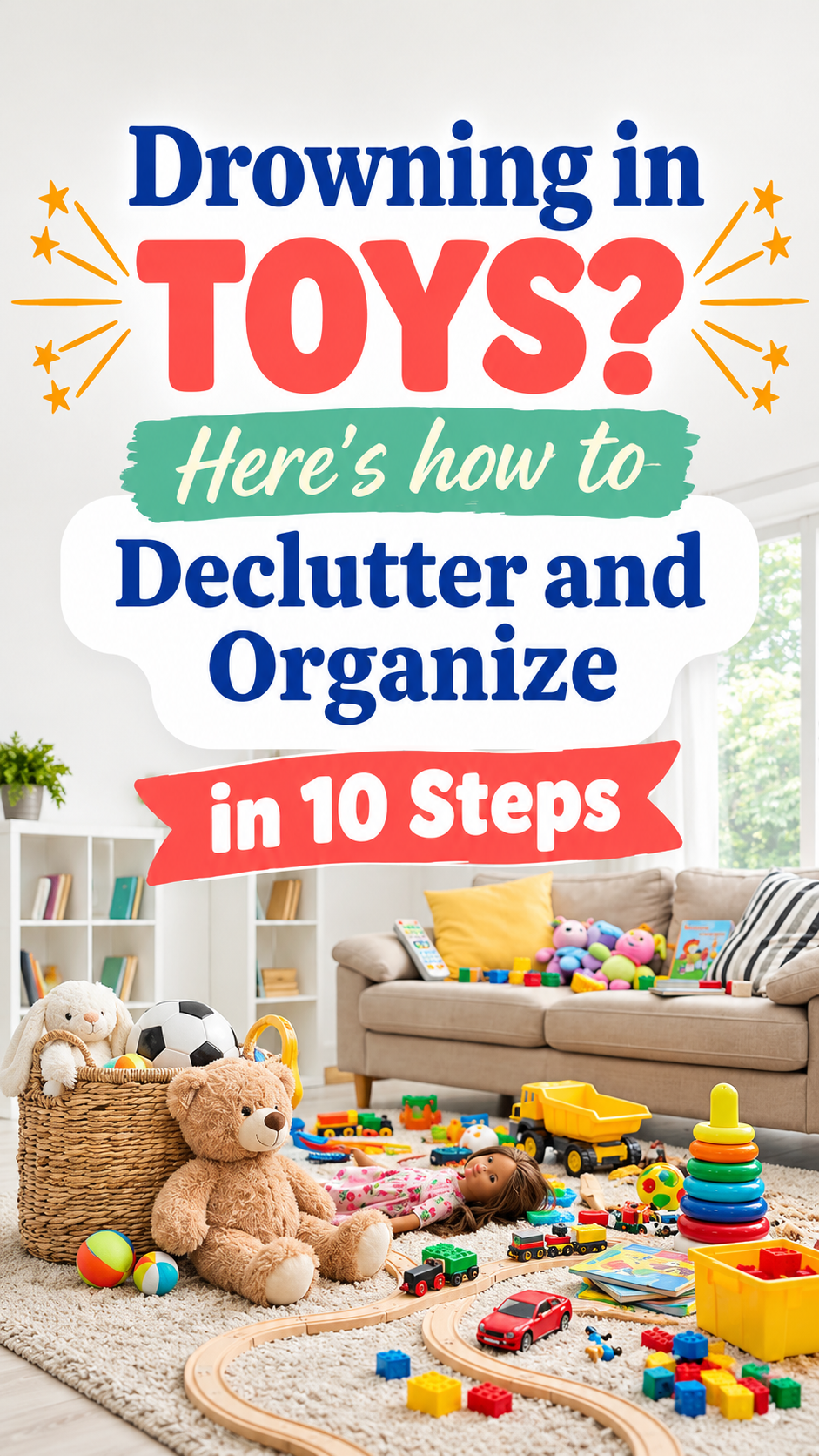
The holidays are over, and now your living room looks like a toy store exploded in it.
New gifts are everywhere. Old toys are buried somewhere underneath. And every few steps, you’re stepping on something small, hard, and plastic. Ouch.
If this sounds like your house right now, don’t worry. You’re not alone, and this mess is totally fixable.
The good news?
You don’t have to wait until the next big holiday or birthday to get things under control. A little toy decluttering can make a huge difference, no matter what time of year it is.
Maybe you need space for all those new gifts. Maybe your kids have outgrown half their toys.
Or maybe you just want your living room back. Either way, this guide will help you get started.
So grab a coffee (or three) and let’s turn that toy explosion back into a home.
Let’s walk through it step by step.
When is the best time to declutter toys?
There’s no perfect time to declutter toys.
The right time is when the clutter starts feeling like too much to handle. And for a lot of families, that moment hits right after the holidays.
Some families try to declutter before the holidays to “make room.” It sounds smart, but it’s tricky when you don’t know what new toys are coming in.
But after the holidays, the picture becomes crystal clear.
You can see exactly what your kids got, what they’re obsessed with, and what’s been sitting untouched at the bottom of the bin for weeks or months.
It’s like the toys sorted themselves into “loved” and “forgotten” without you lifting a finger.
After the holidays, a brand-new year is right around the corner. No matter how cliched it is, it’s widely thought to be a fresh start and an opportunity to create a fresh space.
But as I said, Christmas isn’t the only good time to declutter toys. This guide works for you even if you decide to declutter on a random day in July.
Here are a few other occasions when it makes sense to tackle toy clutter:
- After birthdays: New gifts often mean it’s time to make room for toys your children already own.
- When children outgrow toys: Toys that were once favorites might no longer interest them.
- Before moving homes: Decluttering before packing saves you from moving boxes of toys nobody uses.
- At the beginning of a new school year: It’s a good opportunity to clear out old toys and make room for new activities and routines.
- When storage becomes a problem: If toys no longer fit in their designated spaces, it’s probably time to reassess how much you have.
You don’t need a special occasion to declutter toys. If they’re taking over your home, that’s reason enough!
Before you dive in
Don’t start at 5 p.m.
Seriously.
If your kids are tired or hungry, a toy purge is a recipe for a meltdown.
So, pick a calm morning after breakfast when everyone is in a decent mood. You don’t want to turn a simple decluttering session into a full-blown family negotiation.
Grab your gear
Nothing fancy needed.
Just:
- A donate box
- A trash bag
- A “fix it or find the missing piece” bin
- A “sell or pass to a friend” box
- A few clear bins for the keepers
Decide how much space toys get
This is the secret weapon. Instead of agonizing over every single stuffed animal, decide on the space first.
Stuffed animals get one shelf.
Building toys get two bins. Dolls get one basket. When the basket is full, it’s full. The basket has spoken. Don’t argue with the basket.
When it comes to avoiding clutter at home, it’s always best practice to buy items according to the space you have. Be it clothes or any other items that belong to different rooms in the house.
Once you overestimate the space you have and start thinking, “I’ll somehow fit this into that cupboard,” your clutter problem starts.
So, it’s best to teach your kids from childhood to own stuff according to how much space they have to store it.
Once you have an idea of how much space you have for toys, let’s move on to the next steps.
Step 1: Pile it all up
Round up every single toy in the house. Bedrooms, living room, under the couch, the car, the bathtub, and yes, inside the shoes.
You might briefly wonder how you got here. But seeing everything in one big heap is a real eye-opener.
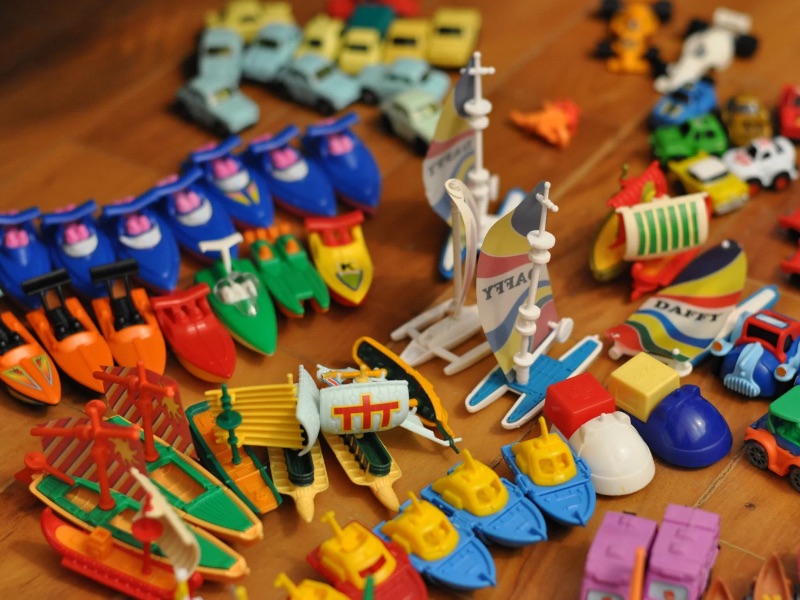
Most parents have no clue how many toy cars live in their home until 30 of them show up in one pile. And your kid only has two hands.
If collecting everything at once feels too overwhelming, work room by room instead.
The idea is to see what you actually own, not to create an even bigger mess that takes three days to clean up.
Step 2: Ditch the broken stuff first
Start with the easy wins to build some momentum. Out go:
- Broken toys that can’t be saved
- Puzzles missing half their pieces
- Markers that dried up long ago
- That toy making a sad, garbled noise because the batteries are on their last breath
Anything that just needs a quick fix goes in the fix-it bin. Give it one week.
If it’s still sitting there broken after that, be honest with yourself. It’s not getting fixed.
Check for damaged and unsafe toys
Before deciding what to donate or pass along, give older toys a quick safety check.
Look out for:
- Sharp edges, cracks, or broken plastic.
- Loose parts that could pose a choking hazard.
- Toys with damaged electrical components or leaking batteries.
- Small pieces that aren’t suitable for younger children in the house.
- Worn-out toys with loose stitching, exposed stuffing, or damaged parts.
Also, check whether any toys have been recalled before passing them on to another family.
Remember, a toy that’s no longer safe to play with shouldn’t end up in someone else’s donation box.
If it can’t be repaired safely, it’s time to let it go.
Step 3: Sort into piles
Group similar toys together:
- Stuffed animals
- Blocks and building toys
- Dolls and action figures
- Cars, trucks, and trains
- Art and craft supplies
- Puzzles and board games
- Pretend play stuff
- Outdoor toys
- Baby toys nobody has touched in ages
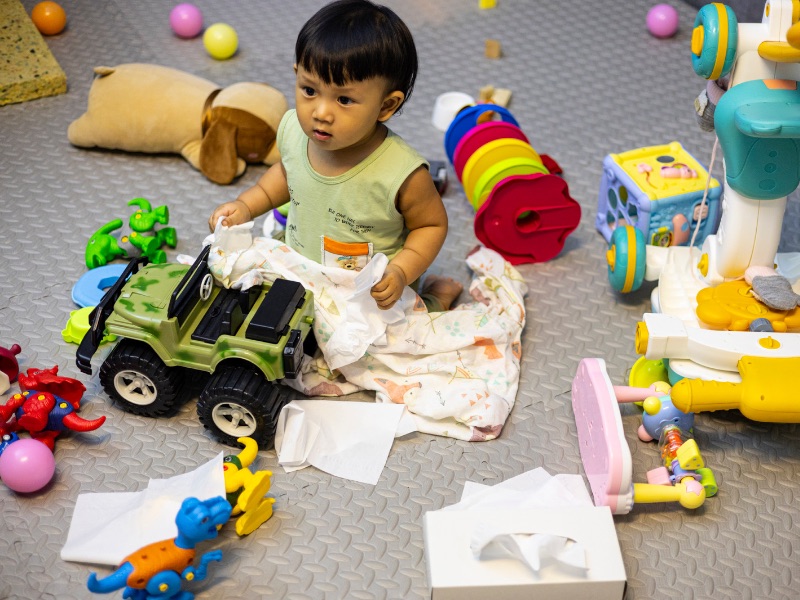
This is where the truth comes out. You might find 25 stuffed animals and exactly one puzzle. At that point, it’s less of a toy collection and more of a plush zoo.
Grouping similar toys together also makes it easier to spot duplicates. You might discover that your kids own three versions of the same toy or have far more building blocks than they could ever use.
Step 4: Ask the tough questions
Go through each pile and ask:
- Has anyone actually played with this lately?
- Has my kid outgrown it?
- Do we own five of the same thing?
- Would anyone notice if it quietly disappeared?
- Does it fit in the space I picked?
If the honest answer is “meh,” it’s time to say goodbye.
Not every toy needs to earn its place by being played with every single day.
Some toys are seasonal favorites, while others are used only during certain activities. Use your judgment rather than getting rid of something just because it hasn’t been touched in a week.
What to keep, donate, or discard
If you’re struggling to decide what stays and what goes, here’s a simple guide.
Keep:
- Toys your children regularly play with.
- Their favorite toys, even if they aren’t particularly expensive or educational.
- Open-ended toys like blocks, building sets, and art supplies that grow with your children.
- Special or sentimental toys, such as a first teddy bear or a handmade gift from Grandpa.
- Toys that a younger sibling will use soon. Box them up and label them by age.
Donate or pass along:
- Gently used toys that are still in good condition.
- Toys your children have outgrown but younger children could enjoy.
- Duplicate toys that are still perfectly usable.
- Games and puzzles with all their essential pieces.
Discard or recycle:
- Broken toys that cannot be repaired.
- Toys with sharp edges or unsafe damaged parts.
- Toys with missing essential components.
- Items that are too worn out or damaged to be useful to someone else.
And remember, you don’t have to get rid of every toy your child hasn’t played with recently. It’s okay to keep a few special things. The goal is to reduce unnecessary clutter, not create an empty house.
Step 5: Bring the kids in (carefully)
This is the part that can go very right or very, very wrong.
Toddlers and preschoolers
Little ones don’t need a vote on everything.
Ask a three-year-old about a toy they haven’t seen in eight months, and suddenly it’s their most precious treasure on earth.
Instead, pull out a few toys, let them pick favorites, and quietly tuck the rest into a “maybe” box. If nobody asks about them in a month, off they go.
School-age kids
Give them a little power. Try, “You get to keep five cars. Pick your top five.”
Kids love being in charge, and they’re often way more ruthless than parents expect.
That toy you spent good money on? Gone without a second thought.
Tweens and teens
Let them handle their own space with a few ground rules. Then mention they can sell old toys and keep the cash. Watch how fast they get to work.
Talk about sharing
Let your kids know their old toys could make another child really happy. A lot of kids love being the hero of that story.
The important thing is to avoid turning decluttering into a punishment.
Let children have a say in what happens to their belongings, especially when it comes to toys they feel attached to.
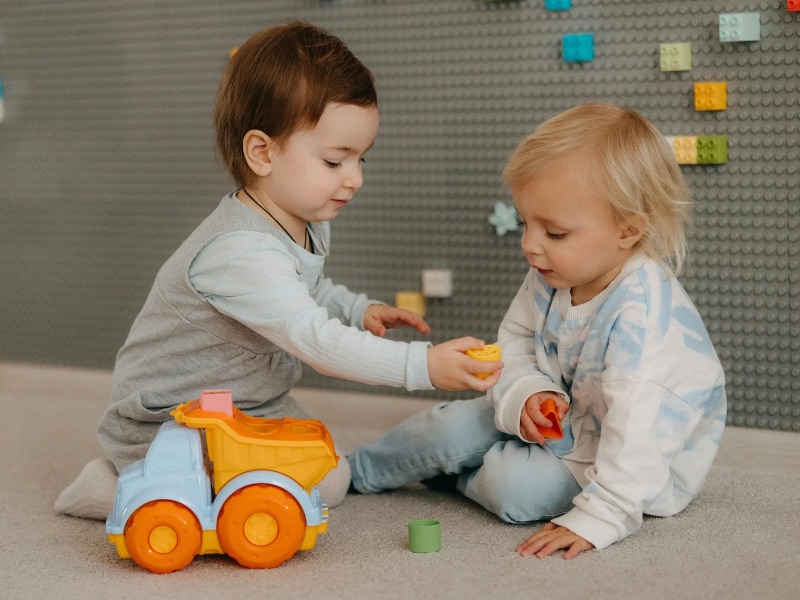
Step 6: One in, one out
For every new toy that came in, one old toy leaves. It’s fair, simple, and easy for kids to understand.
If things are truly out of control (no judgment here), make it two out for every one in.
You don’t have to follow this rule rigidly, though.
Some toys are small, while others take up an entire shelf. The idea is to prevent their toy collection from growing endlessly without considering the space available.
Step 7: Send the toys on their way
Now that you’ve sorted everything, it’s time to get those unwanted toys out of the house.
Donate
Shelters, daycares, preschools, and local charities often welcome gently used toys. Give them a quick call first, since some places only take new items.
Pass them along
Younger cousins, neighbors, and friends with little ones might love a few new-to-them toys.
Just ask before dropping three garbage bags on their porch. Don’t become someone else’s clutter problem.
Sell
Big LEGO sets, play kitchens, ride-on toys, and name-brand dolls can sell well online. Bundle smaller toys into lots so you’re not haggling over a single rubber duck.
Recycle
Some stores and toy brands run recycling programs for plastic toys that can’t be donated. Worth a quick search.
Real talk: Get that donation box out of the house fast. Like, today. Toys left in the trunk have a magical way of sneaking back inside. Nobody knows how. They just do.
Step 8: Organize the keepers
Now for the satisfying part.
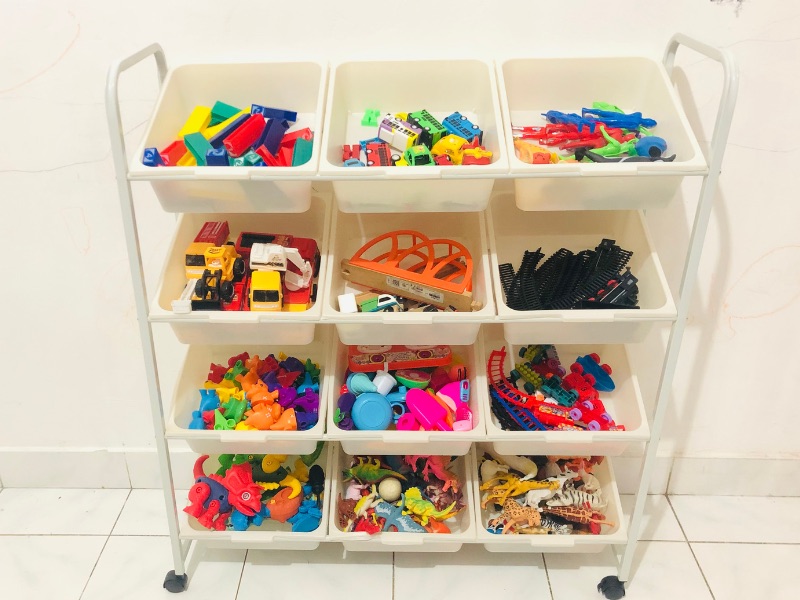
Clear bins and labels
Kids can see what’s inside, so they’re more likely to put things back. For little ones who can’t read yet, stick a picture on each bin.
Keep it low
Everyday toys go on low shelves so kids can grab and put things away on their own. Paint, slime, glitter, and anything that could ruin your carpet stay up high. Way up high.
Corral the tiny stuff
Zipper pouches and small lidded boxes are lifesavers for puzzle pieces, doll shoes, and those teeny LEGO bricks designed purely to attack your feet.
Make cleanup ridiculously easy
If putting a toy away takes more than a few seconds, it’s not happening. Open baskets beat fancy lidded bins every time, especially for younger kids.
You don’t need a complicated storage system or a collection of expensive organizers. Start with what you already have and see what works. The best organization system is one your kids can actually maintain.
Step 9: Try a toy rotation
This one feels like a magic trick. Keep only some toys out and stash the rest in a closet or under the bed. Every few weeks, swap them.
Suddenly the old toys feel brand new. Kids play longer with fewer choices. And cleanup takes half the time. Basically free entertainment, and who’s going to say no to that?
You don’t have to put away half their belongings, either.
Start with a small selection of toys that your children aren’t particularly interested in at the moment. Bring them back into circulation later and see how they respond.
Step 10: Stop the clutter from sneaking back
Decluttering is one thing. Keeping the clutter under control is another. Here are a few simple habits that can help.
Have the gift talk
Before the next birthday or holiday, have a friendly chat with grandparents and relatives.
Something like, “The kids would love a fun day out with you even more than another toy.” Most family members are happy to help.
Ask for experience gifts
A few fun ideas:
- Zoo or museum passes
- Swim or dance lessons
- Movie tickets
- A special outing with grandparents
- Art classes
- A kids magazine subscription
No bins required.
Do quick monthly checks
Ten minutes once a month saves you from another giant pile-up next year. Set a timer, grab a bag, and go.
Start a toy timeout basket
Any toy left out after cleanup goes into a “toy timeout” basket for a few days. If nobody notices it’s missing, that’s your sign.
Avoid buying toys just because they’re on sale
It’s easy to pick up an extra toy because it’s cute, discounted, or something your child might enjoy someday.
But before buying anything, think about whether you actually have space for it and whether your child needs another toy.
A little thought before purchasing can save you a lot of decluttering later.
Final thoughts
Decluttering toys doesn’t have to be a whole saga. Start small, pick your space limits, bring the kids along gently, and ditch the guilt.
You don’t need to get rid of every toy or create a picture-perfect playroom. The goal is to make your home easier to manage and give your children a space where they can actually enjoy playing without being surrounded by more toys than they can handle.
Fewer toys really can mean easier cleanup, less clutter, and a calmer home. So put on your favorite playlist, grab a box, and give that playroom the glow-up it deserves.
Your feet will thank you, one LEGO-free step at a time.
More posts on decluttering:
- 31-day New Year decluttering challenge for a fresh start at home
- 63 Things sitting in your closet that you can declutter today
- How to let go of clothes you are emotionally attached to
- How to Declutter When You’re a Hoarder (and Don’t Know Where to Start)
- The Only 5 Decluttering Questions You’ll Ever Need (Free PDF)
- How to Declutter when You Are Stuck and Overwhelmed with Clutter
- How to stop accumulating clutter before it starts
- 17 common decluttering mistakes you don’t know you’re making (&how to avoid them)
- 100+ things to declutter from your home right now
- 36 ten-minute decluttering tasks to organize your home easily
- 10 daily decluttering habits of people who have tidy homes